- Dr. Serdar Özcan
- 0 Comments
- 243 Views
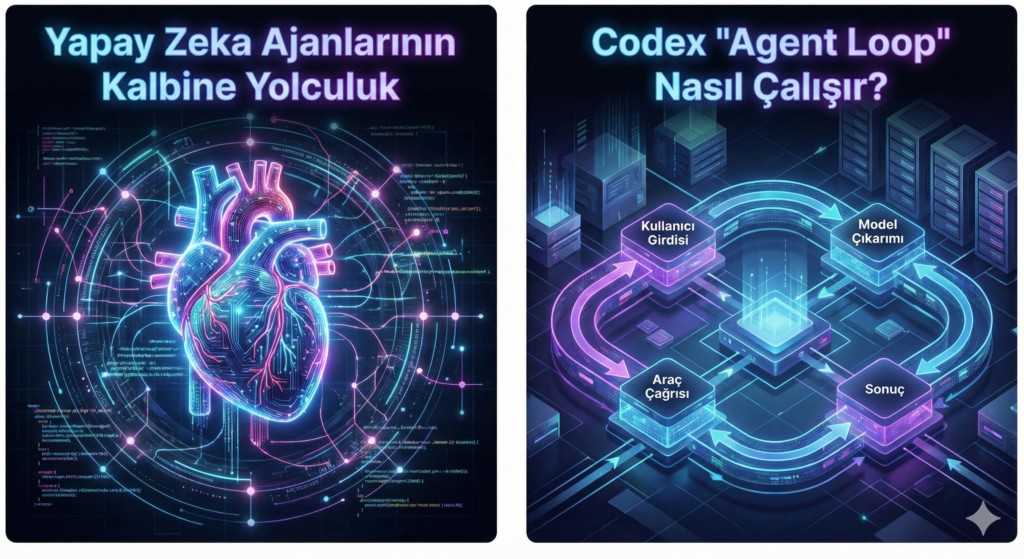
A Journey into the Heart of AI Agents: How the Codex “Agent Loop” Works?
In the software world, AI agents are no longer just assistants; they have become an integral part of our workflows. Today, we’re going “under the hood” of OpenAI’s cross-platform local software agent, Codex CLIto explore the Agent Loop -the core logic that serves as the system’s “brain.”
How does an AI agent understand your command and perform meaningful software work like creating actual files on your machine? Here is the step-by-step breakdown of the Codex design:
1. What is the Agent Loop?
At the heart of every AI agent is a cycle called the “agent loop.” This loop orchestrates the interaction between the user, the model, and the tools. In Codex, the process works as follows:
Prompt Building: User instructions, system guidelines, and tool definitions are structured into a “list of items” and presented to the model.
Inference: The model processes the prompt and generates a response.
Tool Call: The model doesn’t just talk; it can request a tool call (e.g., “run ls and report the output”). Codex executes this tool call in the local environment and appends the result back to the original prompt.
Result: This cycle repeats until the model stops emitting tool calls and instead produces an Assistant Message, signaling that the task is complete.
2. Smart Context Management and Performance
As a conversation grows, so does the length of the prompt, which can eventually exhaust the model’s context window. Codex manages this with two critical strategies:
Prompt Caching: To avoid re-processing the same information, Codex utilizes prompt caching. By placing static content (like instructions) at the beginning, it reuses computation from previous inference calls, making the process linear and highly efficient.
Compaction: When the token limit is reached, Codex uses a compaction endpoint. It summarizes the conversation into a smaller, representative list of items, allowing the agent to continue the work without losing the “latent understanding” of the project.
3. Security and Flexibility
Since Codex CLI operates locally on your machine, safety is paramount. Sandbox: Through a sandbox mechanism, you have total control over file permissions and network access. Flexibility: It is highly configurable, allowing you to use different Responses API endpoints—whether through OpenAI, Azure, or local setups like Ollama and LM Studio.
Why It Matters ?
The ability of agents to not only generate text but also interact with the file system and execute terminal commands is fundamentally transforming software development. TAO AI LAB , we are closely monitoring these “autonomous workflows,” as we believe they will define the standard way of working in the future.
If you want to dive deeper into the technical mechanics of Codex, you can read OpenAI’s original post here or explore their open-source repository on GitHub.
What are your thoughts? Have you started integrating autonomous agents like these into your development cycles? Let’s discuss in the comments!
Reference: 1. https://openai.com/index/unrolling-the-codex-agent-loop/