- Dr. Serdar Özcan
- 0 Comments
- 286 Views
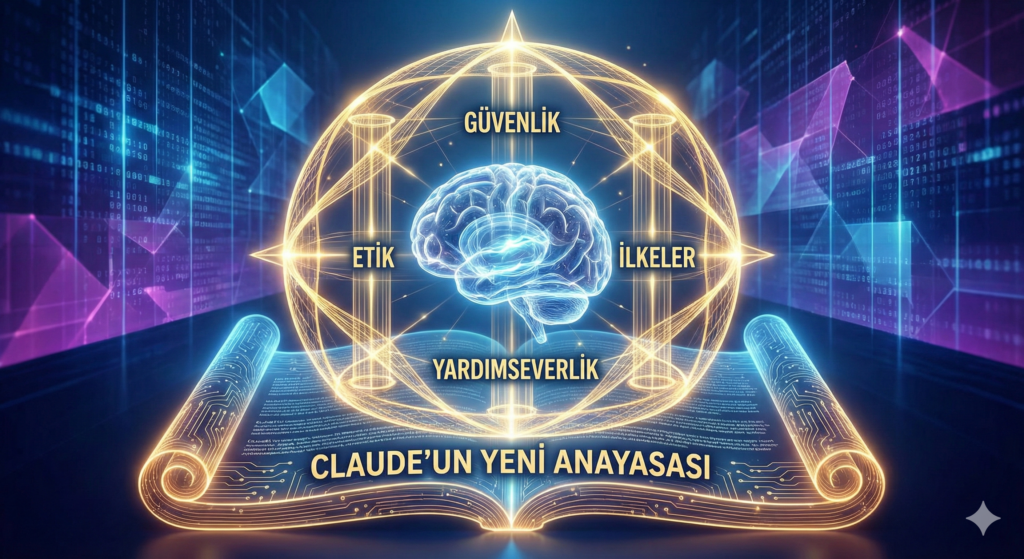
AI’s Moral Compass: What Does Claude’s New “Constitution” Mean?
It’s easy to tell AI models what to do; but how do we teach them why they should behave that way? Anthropic is seeking an answer to this very question with the newly released “Constitution” for its flagship model, Claude.
I’ve summarized the highlights of this new approach, which marks a transition from a static list of rules to a living document of values.
1. From Rules to Principles: Explaining the “Why”
In the traditional approach, AI was given rigid rules like “don’t do X” or “don’t say Y.” However, Anthropic now explains the intentions and reasons behind these rules to Claude.
The Goal: To enable the model to generalize—applying broad principles to make the right decisions in complex and novel situations, rather than mechanically following specific instructions.
2. Hierarchy of Values: Safety First, Helpfulness Last
Anthropic has established a clear hierarchy for Claude to follow when its values appear to conflict:
Broadly Safe: Prioritizing the ability for humans to oversee and correct the AI.
Broadly Ethical: Being honest, wise, and virtuous.
Compliant with Guidelines: Adhering to specific safety protocols (e.g., medical advice or cybersecurity).
Genuinely Helpful: Benefiting the users and operators.
Key Takeaway: Claude now understands that it should never compromise ethical values or safety just to be “more helpful” to a user.
3. The “Nature” of AI: Consciousness and Well-being
This is perhaps the most philosophical and forward-thinking part of the document. Anthropic acknowledges the scientific uncertainty regarding whether AI might have some form of consciousness or moral status. The constitution includes sections that encourage Claude to reflect on its own identity and psychological security. This is the first step toward positioning AI not just as a pile of code, but as a “social actor.”
4. Transparency and the Open Source Spirit
Anthropic released this constitution under a CC0 (Creative Commons) license. This means anyone can freely use, build upon, or critique this set of values. In an era where AI’s societal influence is growing, this level of transparency is critical for building public trust.
What Does This Mean for Us?
TAO AI LAB , our vision of “virtuous AI” becomes even more tangible with steps like this. We believe that AI must be more than just intelligent; it must be wise and principled. Claude’s constitution represents one of the most serious technical and philosophical efforts on this path.
What do you think? Should every AI model have a “constitution”? Or does this risk “over-humanizing” machines? I look forward to your thoughts in the comments!
Detaylı inceleme için: Anthropic – Claude’s New Constitution